
Faites connaître cet article à vos amis:
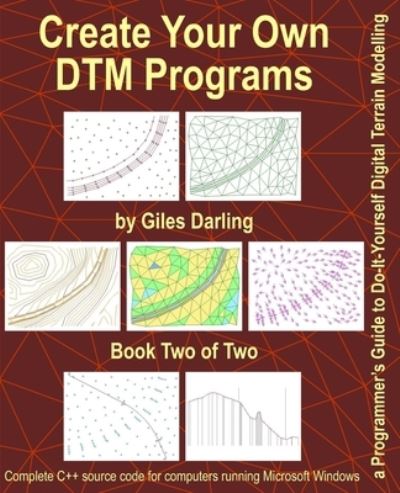
Create Your Own DTM Programs: a Programmer's Guide to Do-It-Yourself Digital Terrain Modelling - Create Your Own Dtm Programs Giles Darling
Commandé depuis un entrepôt distant
 Les cadeaux de Noël peuvent être échangés jusqu'au 31 janvier

Nos clients disent :


Également disponible en tant que :
Create Your Own DTM Programs: a Programmer's Guide to Do-It-Yourself Digital Terrain Modelling - Create Your Own Dtm Programs
Giles Darling
Commercial digital terrain modelling (DTM) programs can be expensive and overly-complicated to use, particularly for smaller or irregularly-shaped sites such as car parks, housing estate roads, or flood-protection earthworks. These two books contain complete listings of C++ source code for a suite of programs that create and work with digital terrain models (DTMs). These programs are written for computers running the Microsoft Windows 7 (or above) operating system. In Book One, Chapters 1 to 3 introduce core components that are used in the rest of the chapters. These core components include:
(i) a text window that doesn't get full or run out of memory,
(ii) a file importer and exporter that converts between a variety of text formats,
(iii) a tool to manage time-intensive number-crunching tasks,
(iv) a graphics window with in-built zoom, pan, and point- and rectangle-selection abilities that can also export images to JPEG files, and
(v) a range of shape classes that manage and interact with arrays of data for a variety of shapes including points, lines, triangles, slope or gradient arrows, and paths or polylines containing lines and arcs. Chapter 4, also in Book One, details the code required to create a DTM from 3D points and optional breaklines and optional boundary lines. The code creates a DTM containing 3D triangles. In Book Two, Chapters 5 to 14 use the triangles created in Chapter 4 for various purposes including:
(i) applying contours to your DTM,
(ii) calculating z values or levels, maximum slopes and slope directions,
(iii) calculating areas and volumes under your DTM,
(iv) identifying high and low points,
(v) calculating flow paths,
(vi) identifying DTM boundaries,
(vii) calculating the intersection and difference in z values or levels between two overlapping DTMs, and
(viii) creating vertical sections or profiles through your DTM along paths or polylines containing lines and arcs. The appendices at the end of Book Two include generic lisp routines to extract point, line, triangle and path data from your CAD drawings, and derivations and proofs of the geometric equations used in the two books. These two books assume that you have at least basic experience of creating programs from C++ source code on a computer running Microsoft Windows. Book One can be used on its own. However, Book Two assumes that you have access to the source code in Book One. All the source code is available from my website, as detailed in Book One.
226 pages
| Médias | Livres Paperback Book (Livre avec couverture souple et dos collé) |
| Validé | 27 décembre 2020 |
| ISBN13 | 9798582012368 |
| Éditeurs | Independently Published |
| Pages | 226 |
| Dimensions | 191 × 235 × 12 mm · 394 g |
| Langue et grammaire | Anglais |


