Faites connaître cet article à vos amis:
The History of Numerals and Number-writing Csaba Varga
Commandé depuis un entrepôt distant
 Les cadeaux de Noël peuvent être échangés jusqu'au 31 janvier

Nos clients disent :


The History of Numerals and Number-writing
Csaba Varga
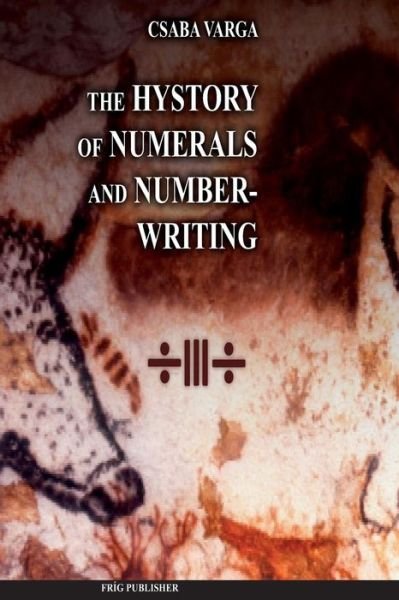
The Author investigated 30,000 years writing-history of humanity in his previous book Signs Letters Alphabet. This book ads to his investigation everything he could find about numbers and number writing in our history. The ancient numerals: the dot, line, a line perpendicular to it (I) and a long line. Every one of these signs marked its own local value. Thus, we can write every number with different arrangements of these four signs. The reader can compare the 17,000-year-old numeral pictured on the front of this book (written on the cave?s wall in Lascaux) with the 19th century signs seen on the inside of this back cover. The earliest found dot-line numeral so far is around 30,000 years old. Finds with such recordings get more numerous as we approach our time. This method was used, unchanged, in Ancient Egypt through its history, in China, by the Mayans, by the Aramaic culture in Middle East, the Eskimos and even in the salt mines of Transylvanian until the start of 20th century. Everybody did it, because there was no other kind of number-writing. We are no exception either. Our ?Arabic? number-writing has a Palaeolithic origin also, except that the signs became over-ornamented in India, changing to ?cifra? (adornment, ciphers), before arriving in Europe. The Palaeolithic calculator had two basic signs: dot and line. The lines could be drawn in the sand as in Egypt or even somewhere in Africa today. The dots could be pebbles, marbles, kernels or shells. The very fast calculator, with wires and beads on them is still used world wide, its name and form varies from abacus (Latin) to soroban (Japan) or from schoti Russia) to suan pan (China).
| Médias | Livres Paperback Book (Livre avec couverture souple et dos collé) |
| Validé | 4 juin 2012 |
| ISBN13 | 9781490484402 |
| Éditeurs | CreateSpace Independent Publishing Platf |
| Pages | 406 |
| Dimensions | 152 × 229 × 21 mm · 539 g |
| Langue et grammaire | Anglais |